Karnataka Rent Agreement on e-Stamp Paper
Drafted by legal experts, executed on a genuine Karnataka e-stamp certificate, couriered across the state — Bengaluru, Mysuru, Mangaluru, Hubballi and beyond. Scan copy reaches you the same working day.
Physical stamp paper no longer works in Karnataka
This is the single most important thing to know before you print anything. Karnataka has moved fully to e-stamping. Physical non-judicial stamp paper is no longer accepted for rental agreements, and an agreement executed on one is exposed in exactly the way you do not want to discover in court.
Issued through the Stock Holding Corporation network or the state's Kaveri portal, and carrying a Unique Identification Number you can verify independently on the SHCIL portal. If a broker hands you a PDF with no UIN, you have nothing. Verify the number before you sign and before you pay any deposit.
A separate 2025 amendment to the Karnataka Stamp Act added support for digital e-stamping and electronic signatures, so a properly e-stamped and e-signed Karnataka agreement now stands on firm statutory ground.
The ₹500 ceiling, and why Bengaluru depends on it
Article 30(1)(i) of the Karnataka Stamp Act, 1957 charges duty on a residential lease of up to one year at 0.5% of the consideration — annual rent together with the security deposit — subject to a maximum of ₹500.
That cap does more work in Bengaluru than anywhere else in India, because Bengaluru runs the highest security deposits in the country. Ten months' rent is a normal ask. Without the ceiling, those deposits would push stamp duty into the thousands on an ordinary flat.
| Lease type and duration | Stamp duty |
|---|---|
| Residential, up to 1 year | 0.5% of rent + deposit, capped at ₹500 |
| Commercial or industrial, up to 1 year | Article 30(1)(ii) — no upper cap |
| 1 to 10 years | 1% of total rent for the lease period |
| Registration fee, where registration applies | 1% of annual rent + deposit, minimum ₹1,000 |
If you are letting a shop, an office or a PG as a commercial arrangement, Article 30(1)(ii) applies and the ₹500 ceiling does not. Getting the article wrong is one of the commonest ways a Bengaluru agreement ends up under-stamped — and an under-stamped instrument is inadmissible as primary evidence until the deficiency and a penalty are paid.
A Koramangala flat, eleven months versus twelve
A 2BHK at ₹35,000 a month with a ₹3,50,000 deposit — ten months, which is standard in Bengaluru. The gap between the two options here is the widest of any state we serve.
- 0.5% of ₹7,70,000 would be ₹3,850
- Capped at ₹500 by Article 30(1)(i)
- No registration, no SRO visit
- Valid and enforceable if properly e-stamped
- Stamp duty 1% of ₹4,20,000 = ₹4,200
- Registration 1% of ₹7,70,000 = ₹7,700
- Plus scanning charges at the SRO
- Both parties attend in person
Roughly twenty-four times the cost for one extra month of term. This is why Bengaluru renews at eleven months rather than signing a year.
Where the twelve-month line comes from
Section 17(1)(d) of the Registration Act, 1908 makes registration compulsory for leases from year to year, or for any term exceeding one year. Eleven months keeps you inside it. Karnataka has not layered an additional state-level registration mandate on short leases the way Maharashtra has — so a properly e-stamped eleven-month Karnataka agreement is valid as it stands.
A properly e-stamped Karnataka agreement is legally valid without notarisation. We can arrange it on request and it does no harm, but it is not required — and it is not a substitute for registration where a lease runs twelve months or more. Notarised vs registered, explained.
Three statutes, and what each one does
Karnataka Stamp Act, 1957
Article 30 sets lease duty — sub-clause (i) for residential with the ₹500 cap, sub-clause (ii) for commercial with none. The 2025 amendment brought in digital e-stamping and e-signatures.
Karnataka Rent Act, 1999
The state's tenancy statute, covering rent, the grounds for eviction and notice requirements. Like most rent control legislation it applies to notified areas and carries exemptions.
Registration Act, 1908
Section 17(1)(d) sets the twelve-month line. Section 49 bars an unregistered lease that required registration from being used as evidence of the tenancy.
The Model Tenancy Act, 2021 is a central model law. Tenancy is a State subject, and Karnataka has not enacted its own version — the Karnataka Rent Act, 1999 remains the operative statute. Anyone telling you a new central rule caps your deposit or forces registration is mistaken.
Four steps, no office visit
Fill the form
Parties, rent, deposit and term.
We draft it
A legal expert, not a template fill-in.
e-Stamp procured
Correct Article 30 sub-clause applied, certificate with a verifiable UIN.
Delivered
Scan the same day, hard copy couriered.
Draft already written? Buy Karnataka e-stamp paper on its own. Unsure of the denomination, see which stamp paper you need.
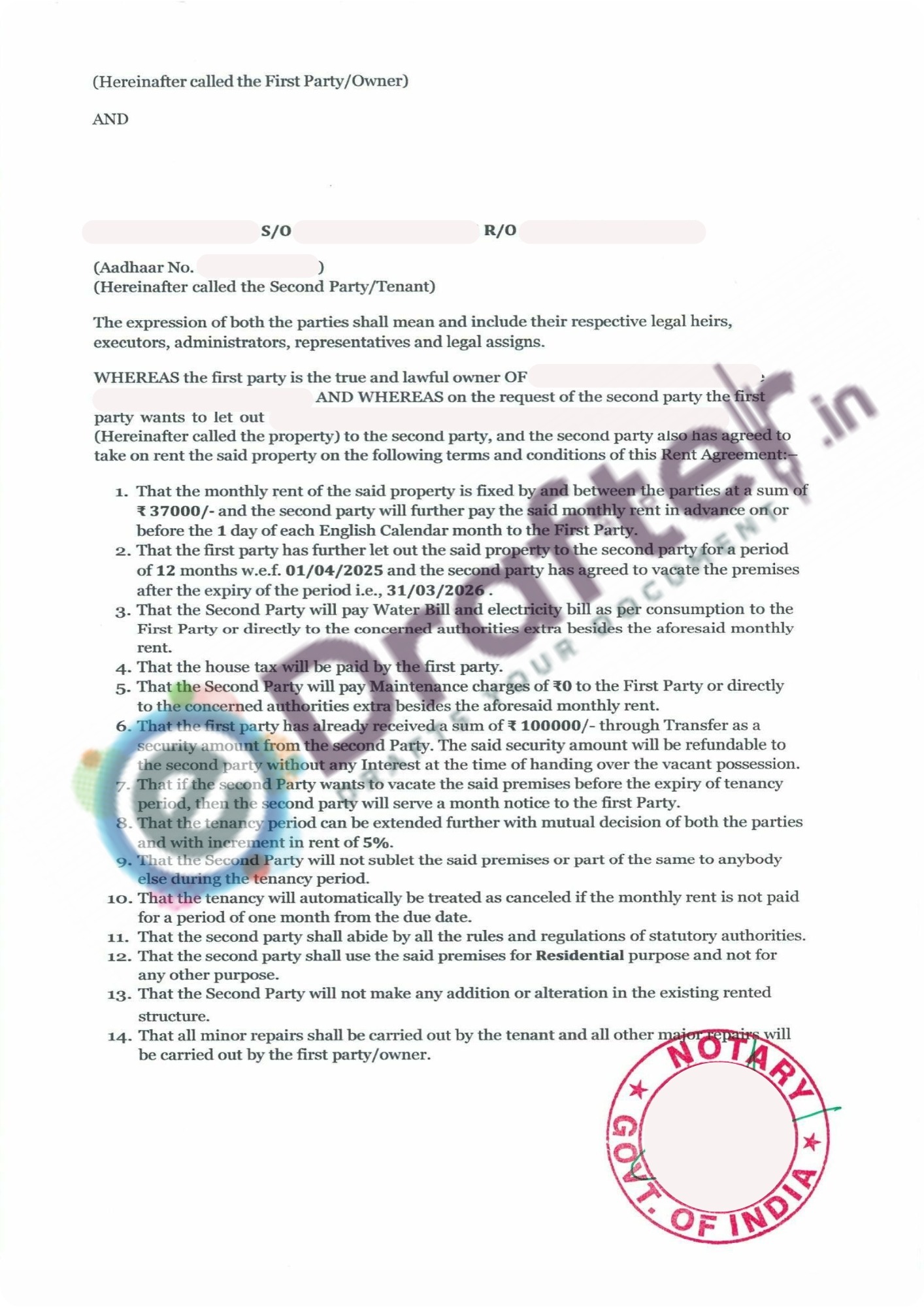
A sample Karnataka rent agreement


Six clauses that decide the dispute
With ten-month deposits in play, Bengaluru's rental disputes are almost always about money already paid. These are the clauses that determine who wins them.
Deposit refund timeline
The highest-value clause in any Bengaluru agreement. Name the number of days and the permitted deductions precisely.
Painting and restoration cap
Bengaluru's number-one deposit fight. Put a rupee ceiling on it in writing, not "as per actuals".
Lock-in period and exit
Landlords here enforce lock-ins strictly. IT job changes are real — spell out the consequence of leaving early.
Annual escalation
A fixed percentage on renewal beats renegotiating every eleven months.
Association and maintenance dues
Who pays the monthly apartment association charge, and what happens if it rises mid-term.
Purpose of use
Residential or commercial. It changes which Article 30 sub-clause applies and therefore your stamp duty.
Four documents
- Aadhaar — landlord and tenant
- PAN — both parties
- Property address and khata or ownership reference
- Signatures of both parties and two witnesses
Tenant police verification
Bengaluru City Police requires landlords to submit tenant particulars for verification, and it is enforced actively across the city.
It is not completed by executing the agreement, and the obligation sits with the landlord, not the tenant.
Five expensive mistakes
- Using a physical stamp paper. Karnataka no longer accepts them for rental agreements. e-Stamp only.
- Accepting a ₹20 or ₹50 e-stamp because someone said it is enough. On any real Bengaluru rent with a deposit, it is not.
- Stamping a commercial letting under the residential sub-clause. Article 30(1)(ii) has no ₹500 cap.
- Leaving restoration "as per actuals". That single phrase costs Bengaluru tenants more deposit than anything else.
- Not verifying the e-stamp UIN. Check it on the SHCIL portal before you sign or pay a deposit. See our drafting do's and don'ts.
Delivered across Karnataka
Start your Karnataka rent agreement
Drafted by legal experts · correct Article 30 duty applied · genuine e-stamp with a verifiable UIN · scan copy the same day
Create your rent agreementFrequently asked
What is the stamp duty on an 11-month rent agreement in Karnataka?
Article 30(1)(i) of the Karnataka Stamp Act, 1957 charges 0.5% of the annual rent plus security deposit, subject to a maximum of ₹500. Because of that cap, most Bengaluru residential agreements land at the ceiling rather than the percentage.
Can I still use physical stamp paper in Karnataka?
No. Karnataka has moved fully to e-stamping for rental agreements. Your certificate should be issued through the Stock Holding Corporation network or the state's Kaveri portal and carry a Unique Identification Number you can verify independently.
Does the security deposit affect stamp duty in Karnataka?
It forms part of the consideration under Article 30(1)(i), so yes in principle. In practice the ₹500 cap means Bengaluru's large deposits rarely change what you actually pay on an eleven-month residential agreement.
Is the ₹500 cap available on a commercial lease?
No. Commercial and industrial leases up to one year fall under Article 30(1)(ii), which carries no upper cap. Stamping a commercial letting under the residential sub-clause is a common and expensive error.
Does an 11-month rent agreement need registration in Karnataka?
No. Section 17(1)(d) of the Registration Act, 1908 makes registration compulsory only for leases exceeding one year. Karnataka has not added a state-level requirement for shorter terms, unlike Maharashtra.
Is notarisation mandatory in Karnataka?
No. A properly e-stamped agreement is legally valid without notarisation. We can arrange it on request, but it is not a substitute for registration where a lease runs twelve months or more.
Renting outside Karnataka?
Stamp duty, registration rules and tenancy law change at every state border. Pick yours below.
Stamp duty figures reflect Article 30 of the Schedule to the Karnataka Stamp Act, 1957, as amended. Registration position per Sections 17(1)(d) and 49 of the Registration Act, 1908. Tenancy law per the Karnataka Rent Act, 1999. Rates are amended from time to time — confirm on the Kaveri portal or with the Sub-Registrar on the date of execution.