Tamil Nadu Rent Agreement on e-Stamp Paper
Drafted by legal experts, stamped correctly for residential or commercial use, and couriered across the state — Chennai, Coimbatore, Madurai, Trichy and beyond. Scan copy reaches you the same working day.
Two registrations, not one
Almost every guide you will read treats registration as a single yes-or-no question answered by the length of your lease. In Tamil Nadu there are two separate registration systems, and they answer to different laws.
1. Sub-Registrar, under the Registration Act, 1908
Section 17(1)(d) makes this compulsory only once a lease exceeds eleven months. Below that it is optional. This is the registration everyone talks about.
2. Rent Authority, under the TNRRRLT Act, 2017
The Tamil Nadu Regulation of Rights and Responsibilities of Landlords and Tenants Act, 2017 set up a Rent Authority and a tenancy portal. This is the one almost nobody mentions.
The TNRRRLT Act created Rent Courts and Rent Tribunals to handle landlord and tenant disputes. Access to those remedies depends on the tenancy being properly stamped and registered with the Rent Authority. Skip it and you keep your contract, but you lose the statutory dispute mechanism the Act was written to give you — which is precisely what you want on the day the relationship goes wrong.
Tamil Nadu enacted this framework in 2017, four years before the central Model Tenancy Act, 2021. It is one of the few states with a genuinely modern tenancy regime rather than a rent control statute from the middle of the last century.
Residential is 0.25%. Commercial is four times that.
Tamil Nadu splits its lease duty by use, and the gap is wide. It also charges on the advance and security deposit together with the total rent for the whole term — the deposit is not ignored the way it is in Delhi or Andhra Pradesh.
| Lease type | Rate | Charged on |
|---|---|---|
| Residential, up to 5 years | 0.25% | Deposit + total rent for the term |
| Residential, above 5 years | 1% | Deposit + total rent for the term |
| Non-residential, any term | 1% | Deposit + total rent for the term |
| Cap on residential duty | ₹5,000 | |
| Registration fee, where registration applies | 1% of value, capped at ₹20,000 | |
That is a non-residential lease and it attracts 1%, not 0.25%. On the Chennai example below, the same numbers produce ₹525 residentially and ₹2,100 commercially. Stamping a commercial letting at the residential rate leaves the document under-stamped, and an under-stamped instrument is inadmissible in evidence until the deficiency and a penalty are paid.
A Chennai flat, both ways
₹15,000 a month with a ₹45,000 deposit, eleven months. Notice that the deposit sits inside the base — that is the step most people miss.
- Total rent ₹1,65,000 + deposit ₹45,000 = ₹2,10,000
- 0.25% of ₹2,10,000
- Well inside the ₹5,000 residential cap
- No SRO visit at eleven months
- Identical base of ₹2,10,000
- 1% instead of 0.25%
- No residential cap available
- Four times the duty for the same premises
The purpose-of-use clause in your agreement is what decides which column you land in. It is not a formality.
Advance rent is restricted, and Chennai has not fully noticed
Chennai has a long habit of asking for large advances — three to six months' rent is routine, and historically it ran higher. The TNRRRLT Act framework restricts how much advance rent a landlord may collect for a residential tenancy, and it also sets out how and when the deposit must come back.
It affects your stamp duty too
Because duty is charged on the advance and deposit as well as the rent, a larger deposit directly raises the bill. Worth knowing before you agree the number, not after.
Put the refund terms in writing
Name the number of days and the permitted deductions. A statutory right you cannot evidence is difficult to enforce in practice.
Register to use the remedy
The Rent Authority route is what the Act gives you for a deposit dispute. It works best when the tenancy is properly stamped and registered.
Eleven months, and what it actually saves
Section 17(1)(d) of the Registration Act, 1908 makes Sub-Registrar registration compulsory once a lease exceeds eleven months. Below that it is optional. What eleven months does not do in Tamil Nadu is remove your stamp duty obligation, or the Rent Authority position described above.
| 11 months | 12 months or more | |
|---|---|---|
| Stamp duty | Payable in full | Payable in full |
| SRO registration | Optional | Compulsory |
| SRO visit and biometrics | Not needed | Both parties in person |
| Registration fee | — | 1% of value, capped at ₹20,000 |
| Evidence value if unregistered | Valid as stamped | Inadmissible under s.49 |
Wondering whether notarising covers it? It does not — see notarised vs registered rent agreement.
Four steps, no office visit
Tamil Nadu runs registration through TNREGINET, the Inspector General of Registration's portal, with e-stamp certificates issued through the Stock Holding Corporation network. Each certificate carries a unique reference you can verify independently.
Fill the form
Parties, rent, deposit, term and whether the use is residential or commercial.
We draft it
A legal expert, not a template fill-in.
e-Stamp procured
Correct rate applied for the use type, duty computed on rent plus deposit.
Delivered
Scan the same day, hard copy couriered.
Draft already written? Buy Tamil Nadu stamp paper on its own. Unsure of the denomination, see which stamp paper you need.
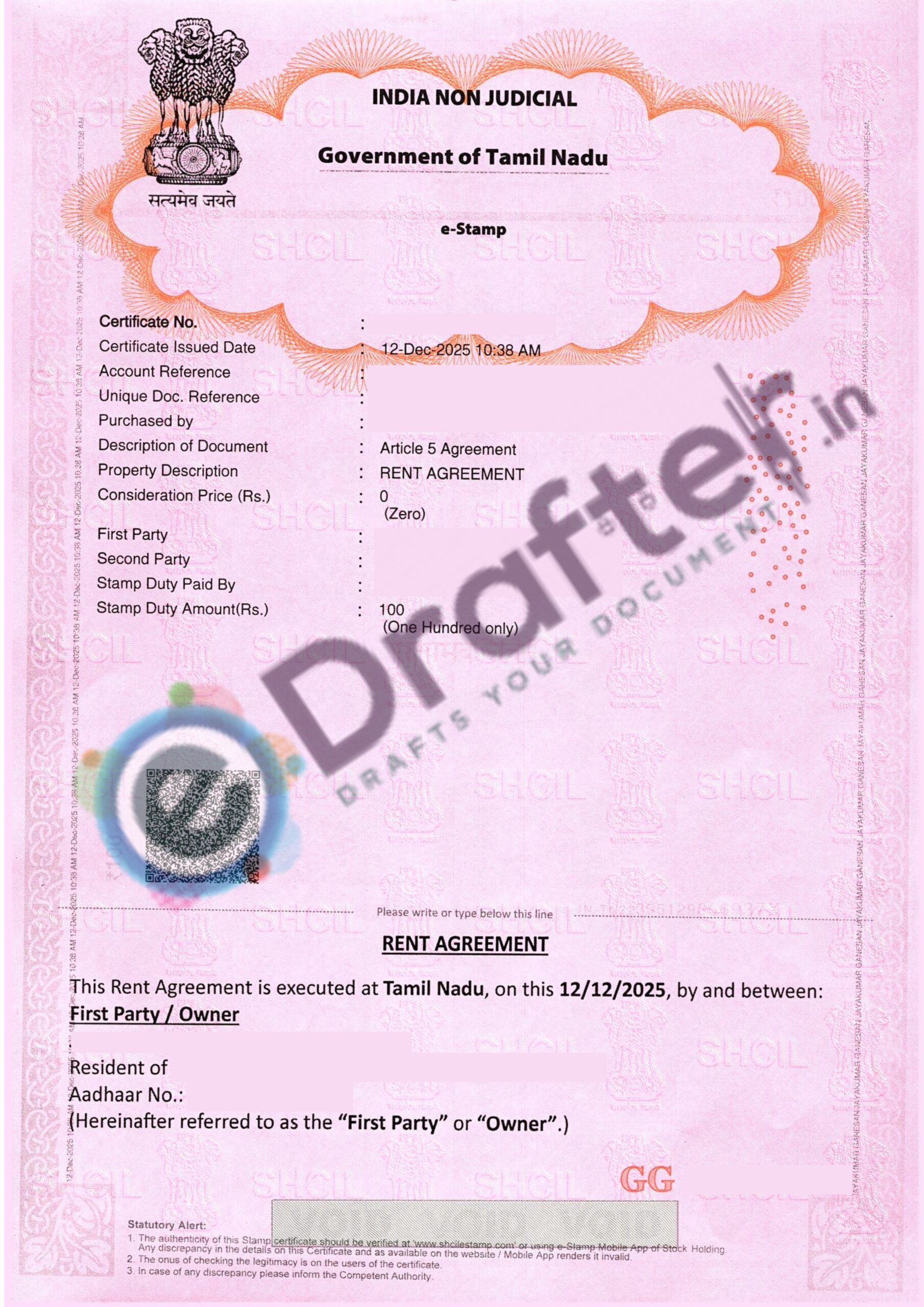
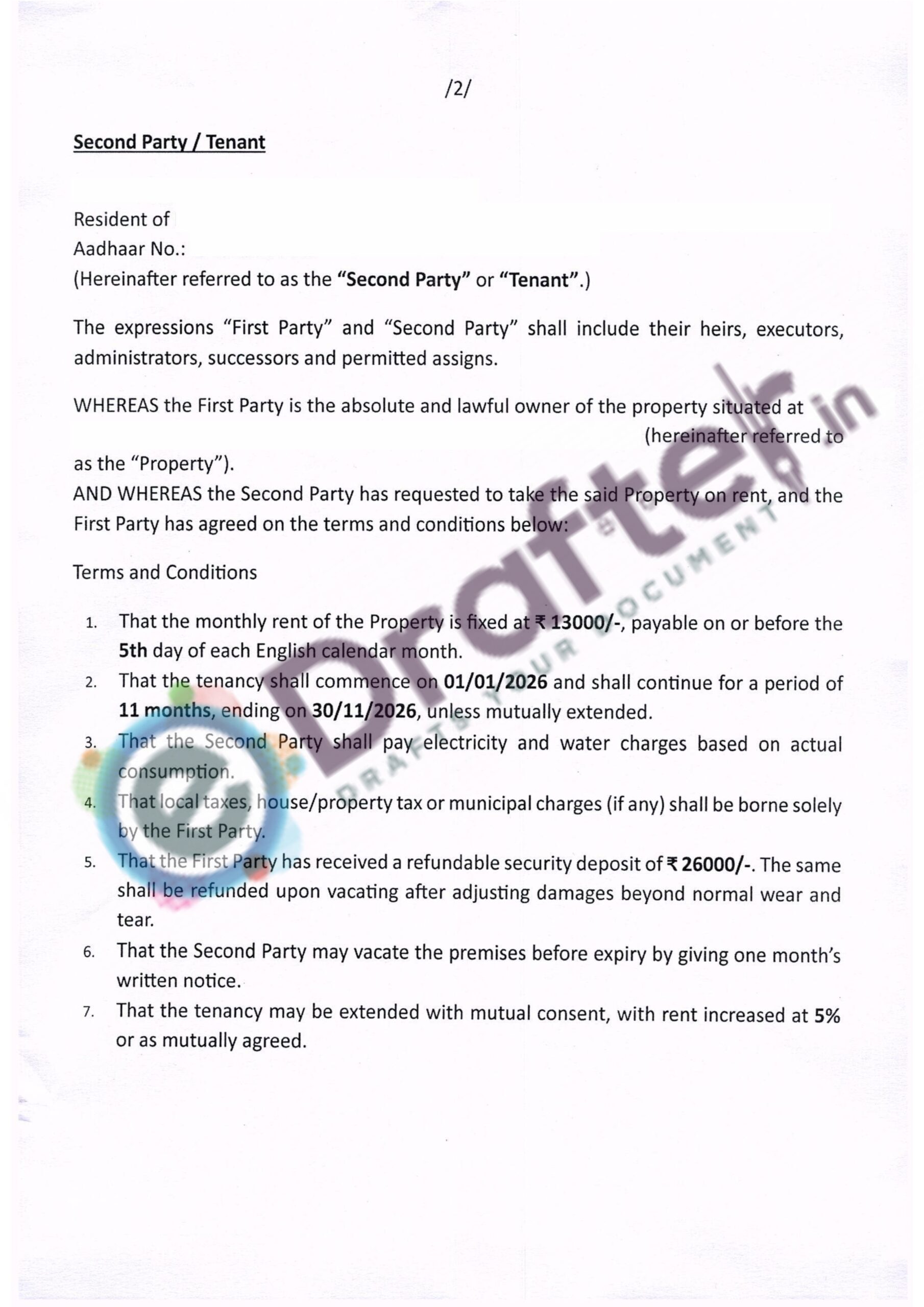
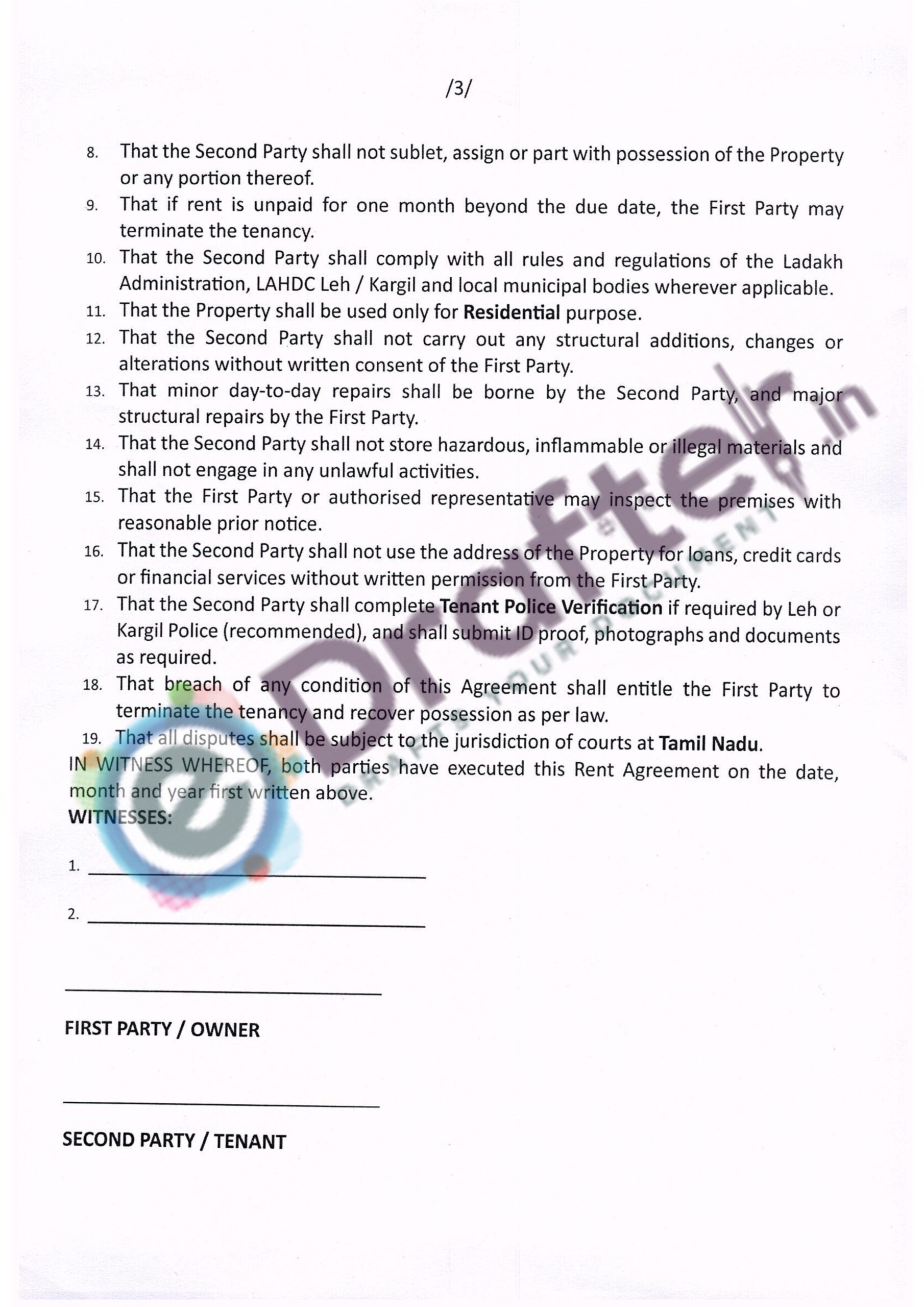
A sample Tamil Nadu rent agreement
Six clauses that decide the dispute
Purpose of use
Residential or non-residential. It decides your stamp duty rate, and in Tamil Nadu that is a fourfold difference.
Advance and refund window
State the advance separately from the deposit, and name the refund days and permitted deductions.
Notice period
State it explicitly and state it both ways. Chennai custom varies by locality and is not a substitute for a clause.
Rent escalation
A fixed percentage on renewal. Most Tamil Nadu tenancies renew at eleven months.
Maintenance split
Structural repairs versus day-to-day upkeep, plus who pays association dues in apartment blocks.
Property description
Full address with door number, street, ward and survey reference. Chennai door numbering has changed over time — be precise.
Four documents
- Aadhaar — landlord and tenant
- PAN — both parties
- Property address and ownership reference
- Signatures of both parties and two witnesses
For a registered lease, the Sub-Registrar will also verify original title documents and the Aadhaar of everyone present.
Tenant verification
Tamil Nadu Police runs tenant verification, and Chennai City Police pushes it actively given the volume of student and IT-corridor tenancy.
It is not completed by executing or registering the agreement, and the obligation sits with the landlord.
Five expensive mistakes
- Stamping a commercial letting at the residential rate. Four times the difference, and the document ends up under-stamped.
- Leaving the advance and deposit out of the base. Tamil Nadu charges duty on them together with the rent.
- Assuming eleven months means nothing further to do. Stamp duty is still payable, and the Rent Authority position is separate from SRO registration.
- Using a ₹20 or ₹50 stamp paper out of habit. It is not what the schedule requires on a real Chennai tenancy.
- A vague deposit clause. See our drafting do's and don'ts.
Delivered across Tamil Nadu
Start your Tamil Nadu rent agreement
Drafted by legal experts · correct rate for residential or commercial use · duty computed on rent and deposit · scan copy the same day
Create your rent agreementFrequently asked
What is the stamp duty on a rent agreement in Tamil Nadu?
For a residential lease up to five years, 0.25% of the advance and security deposit together with the total rent for the entire term, subject to a maximum of ₹5,000. Non-residential leases, and residential leases above five years, attract 1% on the same base.
Is the security deposit included in the calculation?
Yes. Tamil Nadu charges duty on the advance and security deposit together with the total rent payable for the whole term. That is different from Delhi and Andhra Pradesh, where a refundable deposit is left out of the base.
Why is a shop or office more expensive to stamp than a flat?
Because Tamil Nadu splits its lease duty by use. Residential attracts 0.25% up to five years; non-residential attracts 1% whatever the term. On the same numbers that is four times the duty, which is why the purpose-of-use clause matters.
Does an 11-month rent agreement need registration in Tamil Nadu?
Registration at the Sub-Registrar is compulsory only once a lease exceeds eleven months, under Section 17(1)(d) of the Registration Act, 1908. Stamp duty is payable either way, and the position under the Tamil Nadu Regulation of Rights and Responsibilities of Landlords and Tenants Act, 2017 is separate from Sub-Registrar registration.
What is the TNRRRLT Act, 2017?
The Tamil Nadu Regulation of Rights and Responsibilities of Landlords and Tenants Act, 2017. It set up a Rent Authority, a tenancy portal, and Rent Courts and Tribunals for disputes. Tamil Nadu enacted it four years before the central Model Tenancy Act, 2021, and access to the Act's remedies depends on the tenancy being properly stamped and registered.
What is the registration fee for a lease in Tamil Nadu?
1% of the value, capped at ₹20,000, plus a nominal portal fee. It applies where registration at the Sub-Registrar is triggered, which is once the lease exceeds eleven months.
Renting outside Tamil Nadu?
Stamp duty, registration rules and tenancy law change at every state border. Pick yours below.
Stamp duty per the Indian Stamp Act, 1899 as in force in Tamil Nadu. Tenancy framework per the Tamil Nadu Regulation of Rights and Responsibilities of Landlords and Tenants Act, 2017. Registration position per Sections 17(1)(d) and 49 of the Registration Act, 1908. Registration is administered through TNREGINET. Rates are reviewed periodically — confirm with the Sub-Registrar on the date of execution.