Table of Contents
In India, divorce does not come only with an emotional burden but also with a financial responsibility. This financial responsibility is what we call alimony. It is a legal obligation imposed by the court on one spouse to provide financial assistance to the other after divorce. The amount of alimony depends on the income of both spouses, their standard of living, financial responsibilities, age, earning capacity and the needs of the children. The law also does not automatically favour the wife. In several matrimonial statutes, a husband can also claim maintenance or permanent alimony if he satisfies the legal requirements. In this blog, we will look into the different laws that govern alimony, its types, factors while calculating alimony and how eDrafter can help you in the whole process.
What Is Alimony? Alimony vs Maintenance vs Interim Maintenance
Alimony refers to financial support that is either required or voluntarily agreed to be paid by one spouse to another with regard to separation or divorce. Maintenance and alimony are used interchangeably in legal language but may differ in some instances.
- Maintenance is a broader concept that refers to financial support that might be offered to a spouse or children both before and after separation from marital relations.
- Interim maintenance is temporary financial support that is awarded until the case of matrimonial or maintenance is settled. It helps in meeting reasonable expenses for the financially disadvantaged spouse both in litigation and daily life.
- Permanent alimony is financial support granted at the time of or after the final matrimonial decree. Under specific conditions of law and circumstances, alimony may be periodically or in a single payment.
Alimony Laws by Personal Law
Alimony in India is not governed by one single law. There are various personal laws that has provisions governing alimony in India. These include:
- Hindu Marriage Act, 1955-Sections 24 & 25: In case of marriages made under the Hindu Marriage Act, Section 24 provides for Maintenance during Pendency of Proceedings. This provision is made available when either the wife or husband has no adequate and independent means of support sufficient to keep himself/herself and carry on the proceedings. Section 25 relates to Permanent Alimony and Maintenance. This may be a lump sum or an amount that recurs periodically, keeping in mind various considerations including the income and property of both parties, their conduct and other aspects of the case. The crucial point to note about Section 25 is that it is not limited to wives. A husband can claim Permanent Alimony if the statutory requirements are met.
- Special Marriage Act, 1954-Sections 36 & 37: The Special Marriage Act applies to marriages registered under the Special Marriage Act. Section 36 is about Alimony Pendente Lite whereas Section 37 deals with Permanent Alimony and Maintenance. Various considerations including financial status of the parties come into account while determining the relief granted by the court. In this way, the mere fact of one being a husband or wife is of no consequence.
- Personal law of Muslims and the 1986 Act: As far as divorced Muslim women are concerned, the Muslim Women (Protection of Rights on Divorce) Act, 1986 is a significant piece of legislation. Section 3 of the Act takes care of provision and maintenance which is to be made and paid by the former husband within the iddat period. The provisions under the Act also cover mahr or dower and properties belonging to the divorced woman. The Supreme Court has interpreted the term ‘reasonable and fair provision’ in such a manner that it means more than provision for the iddat period. Hence, the legal position cannot be confined to the presumption that the divorced Muslim women have rights of maintenance during iddat only.
- Indian Divorce Act, 1869 (for Christians): In the case of Christians who are covered under the Indian Divorce Act, 1869, Sections 36 and 37 cover the aspect of alimony. Section 36 talks about alimony pendente lite and Section 37 grants powers to the court to give permanent alimony.
- Parsi Marriage and Divorce Act, 1936: The Parsi Marriage and Divorce Act, 1936 too has provisions on maintenance. Section 39 is on alimony pendente lite. The Court may take into account the earnings of the parties and make provision for a reasonable weekly or monthly allowance during the pendency of the proceedings. Section 40 is on alimony and maintenance. The Court may direct payment of either a lump sum or a periodical allowance taking into consideration the earnings, property and other circumstances of the parties.
- Sec. 144 BNSS (earlier Sec. 125 CrPC)-Secular provision for all: Section 144 of the Bharatiya Nagarik Suraksha Sanhita, 2023 is the contemporary version of the well-known maintenance provision in Sec. 125 of the old Code of Criminal Procedure. It provides a speedy remedy when a person having means neglects or refuses to maintain his wife, unable to maintain herself, children unable to maintain themselves, and dependent parents, as specified under the law. An interim maintenance can also be provided during the pendency of the case. Notably, the explanation to Sec. 144 covers divorced women as wives.wife.
Types of Alimony in India
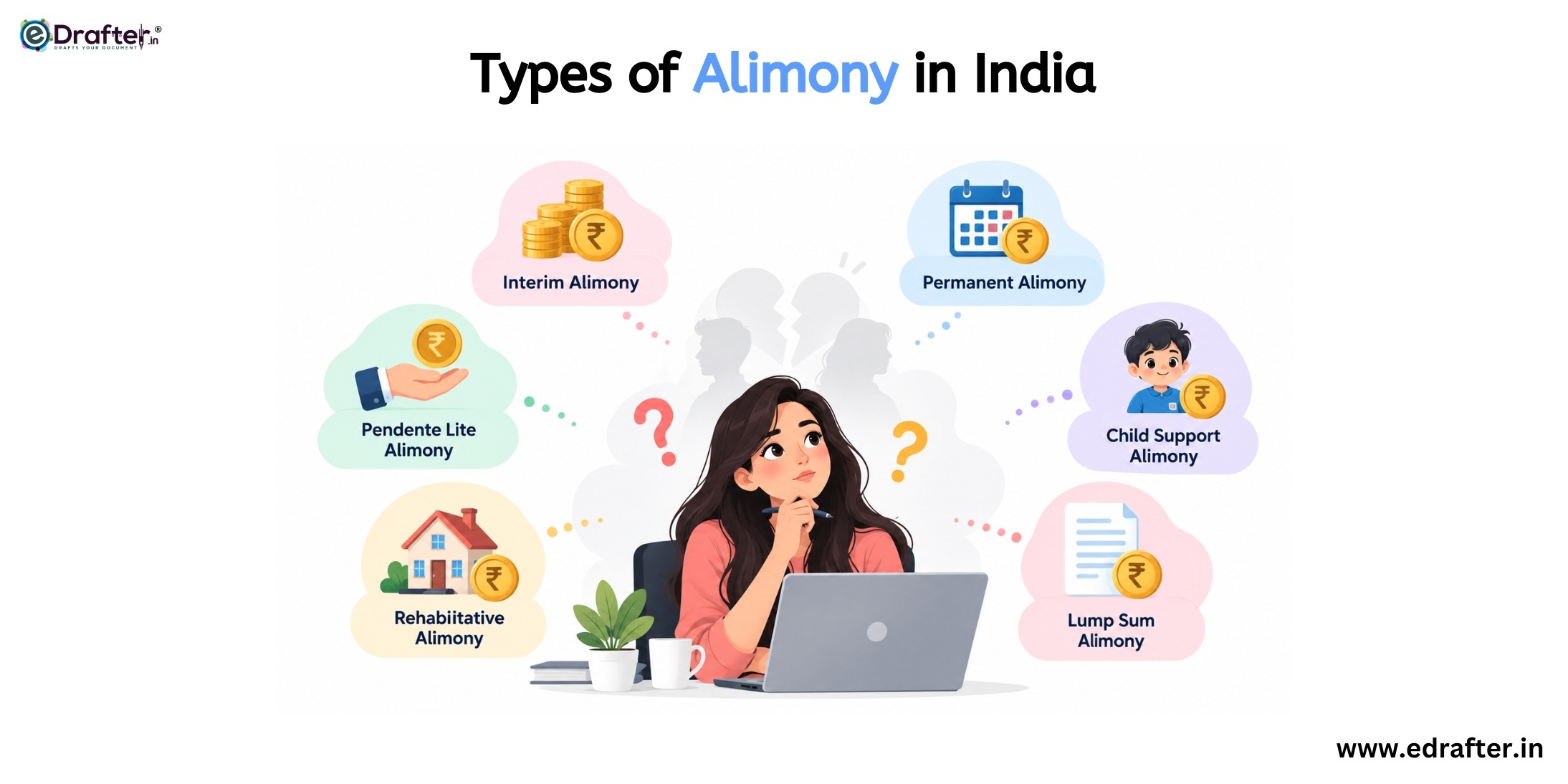
Alimony can broadly take different forms depending on the stage of the case and the applicable law.
- Interim maintenance (pendente lite): Interim maintenance is paid during the pendency of a matrimonial or maintenance proceeding. It is intended to ensure that a financially weaker spouse is not left without reasonable financial support merely because the divorce case is taking time. It may cover reasonable litigation expenses, depending on the applicable provision.
- Permanent alimony: Permanent alimony is financial support granted at or after the final matrimonial decree. It may be ordered as a monthly amount, a periodical payment or a lump sum, depending on the applicable law and circumstances.
- Monthly maintenance vs one-time lump sum settlement: A court may order continuing monthly or periodical payments. Alternatively, spouses may agree to a one-time lump sum as part of a divorce settlement. A lump sum can provide financial certainty and bring financial claims between the spouses to an end if the settlement is properly drafted and accepted by the court. A monthly arrangement, however, may be more appropriate where the financial circumstances of the parties or the recipient’s needs require continuing support.
- Child maintenance: The court considers the child’s needs, education, healthcare and general welfare along with the financial capacity of the parents. A spouse cannot simply treat the amount payable for a child as part of their own alimony.
How Is Alimony Calculated in India?
In India, there is no statutory formula or specific percentage in determining alimony. The court, however, usually takes into account the actual financial position of both spouses in order to determine what amount would be reasonable under the particular circumstances. It is stressed in the case of Rajnesh v. Neha that the court must take into account the disclosure of all sources of income, as well as assets, liabilities, and expenses when making a decision regarding maintenance. Simply put, the calculation involves the following factors:
- What does the person seeking maintenance reasonably need?
- What can that person contribute from their own income and assets?
- How much can the other spouse reasonably afford after meeting their own legitimate expenses and responsibilities?
The Rajnesh v. Neha (2020) framework & affidavit of disclosure
One of the significant judgments of the Supreme Court on maintenance is the case of Rajnesh v. Neha. In this judgment, a format was given for conducting maintenance cases, which was that both parties must submit an Affidavit of Disclosure of Assets and Liabilities. These affidavits require information about the financials of individuals including their income, employment, assets, liabilities, expenses, and previous maintenance payments, if any. The Supreme Court has stated that the above mentioned format must be adopted in all maintenance cases throughout the country as per the directions given in the judgment.
For example, a person earning ₹2 lakh per month may have substantial housing expenses, dependent parents, existing child-support obligations or business liabilities. Another person earning the same amount may have very different financial responsibilities.
The 25% of net income benchmark and why it isn’t a rule
One of the most searched questions about alimony is whether a wife automatically gets 25% of her husband’s salary. But that’s not how the court calculates alimony. The Supreme Court in Kalyan Dey Chowdhury v. Rita Dey Chowdhury upheld an amount that was based on 25% of the husband’s net salary in the facts of that particular case. The Court also made it clear that maintenance depends on the factual circumstances and the amount must be appropriate to the status and capacity of the parties. Therefore, 25% should not be treated as a compulsory formula for calculating alimony in India.
Factors courts actually weigh
- Income and assets of both spouses: The court looks beyond basic salary. Income from employment, business, profession, investments and other sources may be relevant. Property and other assets may also be considered.
- Standard of living during marriage: Maintenance is not intended merely to keep a person alive. The Supreme Court has recognised that the recipient should be able to maintain a reasonable standard of living consistent with the circumstances of the marriage, while also ensuring that the paying spouse is not subjected to an unreasonable financial burden.
- Duration of the marriage: The length of the marriage can influence the assessment. A long marriage involving significant financial dependence may present very different circumstances from a short marriage where both spouses have remained financially independent.
- Age, health and earning capacity: Age, physical or mental health, education, professional qualifications and actual earning capacity can all matter. However, being educated or technically capable of working does not automatically mean that maintenance must be denied. The Supreme Court has held that the mere fact that a wife is earning, or is capable of earning, does not by itself bar a maintenance claim. The court has to consider whether her actual income is sufficient for her support in the circumstances.
- Custody of children: Where children are involved, the financial burden of their education, healthcare, housing and everyday needs may affect the amount of maintenance. The parent who has primary care of the children may also have greater day-to-day expenses.
- Liabilities and existing dependents: Courts also consider genuine financial obligations. For example, a spouse may have dependent parents, children from another marriage, housing loans or other legally significant responsibilities. This was also relevant in Kalyan Dey Chowdhury, where the husband’s second marriage and child from the second marriage were considered while modifying the amount.
Can a Husband Claim Alimony from His Wife?

Yes. The idea that only a wife can receive alimony is incorrect. For example, Section 25 of the Hindu Marriage Act permits permanent alimony and maintenance in favour of either spouse. Section 24 also permits maintenance pendente lite where either spouse lacks sufficient independent income for support and litigation expenses. Therefore, a husband who is financially dependent and satisfies the applicable legal requirements may seek maintenance from his wife.
When Alimony Can Be Denied or Reduced
There are certain situations when the alimony of a spouse can be either reduced or denied. These circumstances involve:
- Adultery, desertion and remarriage: Certain maintenance provisions contain specific restrictions where the claimant is living in adultery, refuses to live with the spouse without sufficient reason, or the parties are living separately by mutual consent. Section 144 of the BNSS expressly contains such restrictions for proceedings under that provision.
- Wife with sufficient independent income: Having a job does not automatically disqualify a wife from receiving maintenance. The real question is whether her income is sufficient to meet her reasonable needs in the circumstances. A high or stable independent income may reduce or eliminate the need for spousal maintenance, while a small income may not be enough to do so.
- Mutual consent divorce with waiver: In a mutual consent divorce, spouses can negotiate financial terms between themselves. They may agree that neither party will claim permanent alimony from the other, or they may agree upon a specific lump sum or monthly payment. However, the settlement should clearly record what claims are being settled and should be placed before the court as part of the mutual consent proceedings.
Alimony in Mutual Consent Divorce vs Contested Divorce
In a mutual consent divorce, the parties generally have greater control over the financial settlement.
They can negotiate:
- Permanent alimony
- One-time settlement
- Monthly maintenance
- Child support
- Division or return of specified assets
- Full and final settlement of financial claims
However, in a contested divorce, the court decides maintenance after considering the evidence and financial circumstances of the parties. This does not mean that alimony is automatically higher in a contested divorce. The amount still depends on the facts and applicable law.
Landmark Supreme Court Judgments on Alimony
Several Supreme Court decisions have shaped the law on maintenance and alimony in India.
- Rajnesh v. Neha (2020) is particularly important for financial disclosure, overlapping maintenance proceedings, the date from which maintenance should generally be awarded and enforcement of maintenance orders.
- Kalyan Dey Chowdhury v. Rita Dey Chowdhury (2017) is frequently cited for the 25% net-income benchmark, but it should not be misunderstood as creating a universal rule. The judgment itself recognised that maintenance depends on the facts of each case.
- The Supreme Court has also repeatedly emphasised that the purpose of maintenance is dignity and reasonable financial support, rather than allowing either spouse to become financially destitute or requiring one spouse to maintain the other without regard to their own legitimate needs.
How to Enforce an Alimony Order If Payment Stops
Alimony order is not just a guideline; in case of willful non-compliance by the paying party, enforcement can be sought through the proper judicial process. The form of action taken for enforcement will depend on the provision under which the maintenance order is granted.
Under Section 144 of the BNSS, itself, there is provision of enforcement in case of non-compliance with maintenance orders, whereas orders of matrimonial maintenance can be enforced according to the pertinent matrimonial law as well as civil execution proceedings. The Supreme Court of India in the case of Rajnesh v. Neha dealt with the matter of enforcement of maintenance orders. In case of discontinuation of payments, it becomes imperative to keep a record of the court order, payments and bank statements.
Tax Treatment of Alimony in India
The tax treatment of alimony can depend on the nature and structure of the payment. There is no simple rule saying that every amount received as alimony is automatically taxable or automatically exempt. Indian judicial decisions have distinguished between recurring monthly alimony and certain lump-sum alimony receipts. In Princess Maheshwari Devi of Pratapgarh v. Commissioner of Income Tax, the Bombay High Court treated monthly alimony as income in the circumstances of that case, while treating a particular lump-sum payment as a capital receipt.
Other tax decisions have similarly treated certain lump-sum divorce settlements as capital receipts where the facts supported that characterisation. Because tax treatment can depend on the wording of the settlement, the nature of the payment and the applicable tax law for the relevant year, a person receiving or paying a substantial alimony amount should obtain tax advice before finalising the settlement.
Do It in the Right Order-Gazette First, Then Every Other Document Follows
Divorce can sometimes be followed by a name change, particularly where a person wants to return to a maiden name or adopt a different surname. A Gazette notification is not a mandatory step in every divorce case and divorce itself does not automatically require a Gazette publication.
However, where a person chooses to legally change their name and needs a formal government record for updating documents, the Gazette process can become important. Where an individual decides to make a legal name change following divorce, then he may be required to fill out certain forms like the name change affidavit, newspaper advertisement and gazette documents, among other related papers. This is where having your paperwork sorted out will save you time.
The eDrafter Name Change Package can help sort out your name change documentation procedures. From the information available in the package currently, the eDrafter’s services can offer help in preparation of the affidavit, newspaper and gazette documents. It is also noted that the Premium and Priority+packages help in submission and tracking of the gazettes. A divorce decree is necessary in case of a name change after divorce.
FAQs
Is there a fixed formula for calculating alimony in India?
No. There is no fixed statutory formula for calculating alimony in India. The court considers the income and assets of both spouses, their standard of living, needs, earning capacity, liabilities, age, health, children and other relevant circumstances.
Can a husband claim maintenance from his wife?
Yes. Under laws such as the Hindu Marriage Act, a husband can claim maintenance or permanent alimony if he satisfies the applicable legal requirements.
What’s the difference between interim maintenance and permanent alimony?
Interim maintenance is financial support provided while a case is pending. Permanent alimony is generally granted at the time of or after the final matrimonial decree. The amount and duration depend on the applicable law and facts of the case.
Can an alimony order be changed later?
In appropriate cases, yes. Some matrimonial statutes expressly permit an order of permanent alimony to be varied, modified or rescinded when circumstances change. For example, Section 25(2) of the Hindu Marriage Act allows modification where there is a change in the circumstances of the parties.
Is alimony decided differently in mutual consent divorce?
The process can be different because the spouses can negotiate the financial settlement themselves. They may agree on a lump sum, monthly maintenance or a waiver of future alimony claims. The terms should be clearly recorded in the settlement and placed before the court as part of the mutual consent divorce proceedings.
Conclusion
There is no fixed answer to the question of how much alimony a wife or husband will receive in India. The court looks at the complete financial picture. Income, assets, expenses, standard of living, age, health, earning capacity, children, liabilities and the duration of the marriage can all affect the final amount. For anyone dealing with divorce alimony, the most important step is therefore to make a complete and honest disclosure of income, assets, liabilities and expenses. A realistic financial picture gives the court a proper basis for deciding what is fair.