Table of Contents
In an organisation, there are certain terms of working for everyone working, whether they are an employer or an employee. When those terms are violated, disputes arise. Employers often face situations where an employee work in outside their authority or breaches any policy of working. In such cases, an employer might send a formal document, which is a legally valid intimidation to their employee, known as a legal notice.
A legal notice helps the employer clearly communicate the problem, demand compliance, and warn of legal consequences if the matter is not resolved. It also creates a written record that can be relied upon if the dispute escalates.
What is a Legal Notice from Employer to Employee?
A legal notice from employer to the employee is a formal written communication issued by the employer, usually through an advocate. It informs the employee about a breach of contractual terms. This notice clearly states the issue, refers to the employment agreement or company policy, and demands corrective action within a specified time. A legal notice to an employee is often the first step before initiating disciplinary action or legal proceedings.
Example: When an employee terminates employment without any notice, an employer may take action against them.
Can a Company send a Legal Notice to an Employee?
Yes, a company has the legal right to send a notice to an employee. If an employee violates these terms or misconducts an activity, the company can issue legal notice against employee.
Also Read, Legal Notice vs Court Notice
In What Cases Can an Employer Send a Legal Notice Against an Employee?
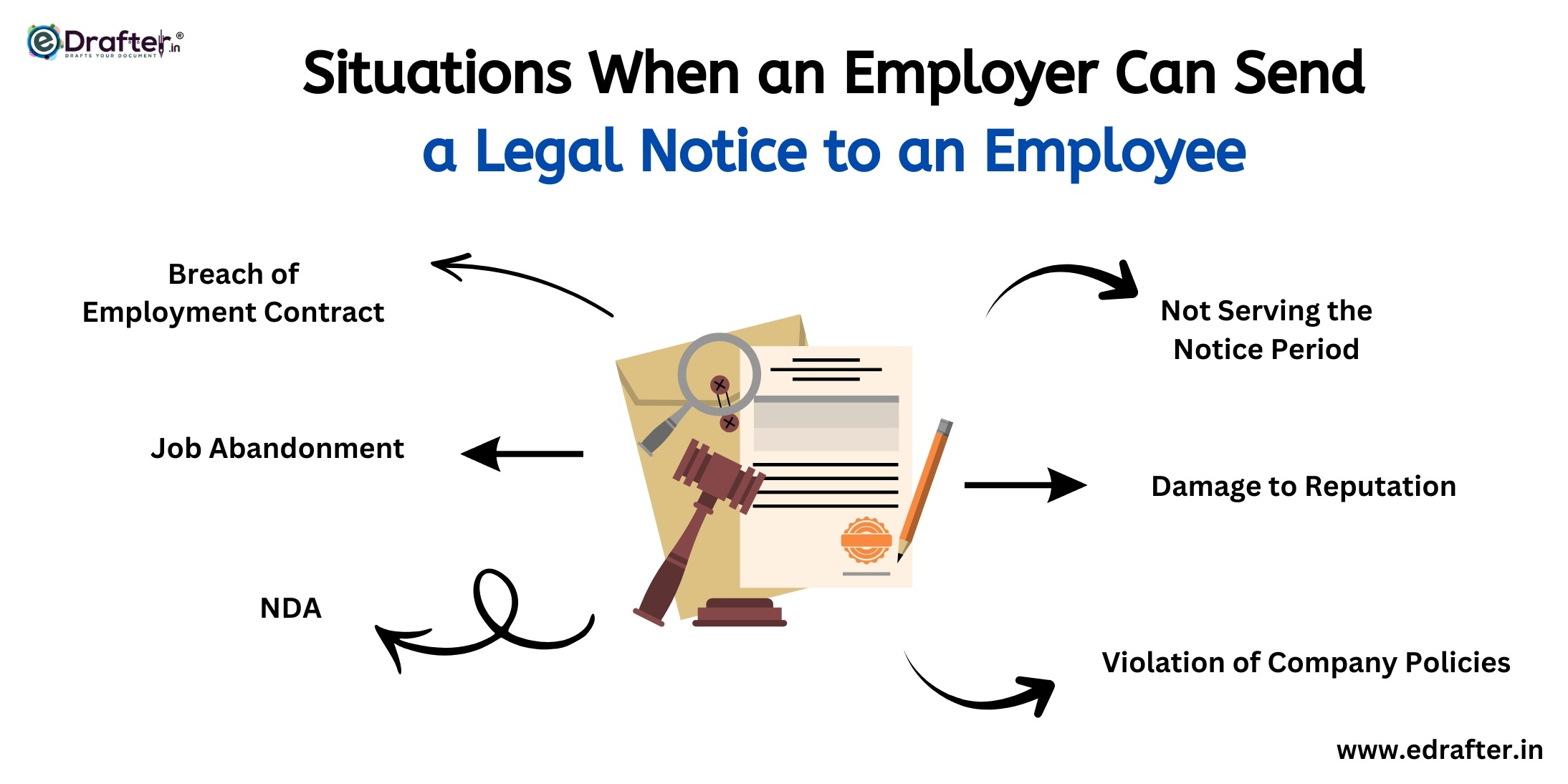
An employer may send a legal notice in situations such as resignation without serving the notice period, abandonment of employment, breach of confidentiality, violation of non-compete clauses, misconduct, insubordination, or causing financial loss to the company.
Other common reasons include refusal to hand over company property, misuse of company data, or non-compliance with employment terms mentioned in the offer letter or appointment letter.
Can I Resign without Notice Period?
Every company has its own set of rules and terms. Notice period to resign depends on the contractual terms of that company. Most offer letters clearly mention the notice period required for resignation. While a company would never stop someone from resigning, the least it expects is the service of notice period. If your offer letter mentions a specified notice period for resigning, you must serve it. Non compliance to contractual terms may lead to legal notice against employee.
Is It Compulsory to Serve Notice Period?
In most contracts, the time for the notice period is mentioned. However, an employee cannot be forced or compelled to do it. It is advisable to serve the notice period as it would help the employer find a new employee, and the employee on notice period would get the salary without any deductions. It benefits both parties. The notice period helps ensure a smooth transition and proper handover of responsibilities. Failure to serve the notice period without approval may lead to legal consequences, including the issuance of a legal notice against employee.
Also Read, Types of Legal Notice
What are the Employee Resignation Rules and Regulations in India?
India does not have a single uniform law governing employee resignation for all sectors. Resignation rules are primarily governed by the employment contract, company policies, and applicable labour laws. Employees are legally allowed to resign from their jobs at any time. However:
- Employees are expected to comply with the notice period requirements stated in their appointment letter.
- The notice period usually ranges from 15 days to three months, depending on the role, organization, and contractual terms.
- Courts generally uphold reasonable notice period clauses agreed upon by both parties.
You can read our blog of how to reply a legal notice against your employers? Whether you are innocent or fake alligation on you then our detail blog helps you to get your salary and other’s documents like experience letter, salary slip. etc that held by the employers.
What Happens If You Don’t Serve Notice Period?
If an employee does not serve the notice period, it is considered a breach of terms. The employer may withhold relieving letters, experience certificates, or even deduct salary. The employer may initiate legal proceedings to recover losses caused by sudden resignation or non-compliance. All of this could affect your future hirings or may reflect a negative reference.
How to Send Legal Notice to an Employee?
Sending a legal notice through eDrafter is simple and fully online.
- You start by visiting edrafter.in and selecting the legal notice format as per your case under legal services.
- You will be required to fill in your details.
- Once it is done, you are connected with an experienced advocate.
- The advocate drafts the notice based on employment laws and contractual terms.
- You can review the draft and suggest changes if required.
- Once finalised, the legal notice is sent to the employee
For lower value case, you can obtain our Zapp legal notice service just at 299/- only and get the issue resolve at earliest.
Is the Notice Period Legal in India?
Yes, notice period clauses are legal in India as long as they are reasonable and mutually agreed upon. Courts have consistently held that notice periods mentioned in employment contracts are enforceable. However, excessively long or unfair notice periods may not be upheld if challenged.
Can I Get a Relieving Letter Without Serving Notice Period?
Generally, employers issue relieving letters only after the notice period is served. However, an employer might provide you with a relieving letter subject to negotiations and payment of penalties, if required. Approval of the notice period is required for obtaining a relieving letter.
Can We Ignore a Legal Notice from the Employer?

Any person is not obliged to reply to legal notice. However, it is not advisable. Silence can be interpreted as acceptance of what the sender is trying to say, especially in civil disputes. If an employer sends a legal notice, the employee should reply within the given time and clarify their position.
A proper reply helps protect the employee’s rights and prevents unnecessary escalation.
What Is the Supreme Court Judgement on Employee Notice Period?
Recently, the Supreme Court in Vijaya Bank vs Prashant B Narnaware 2025 INSC 691 held that employers can enforce a reasonable and written clause regarding the serving of notice period. The court held that when an employee voluntarily agrees to contractual terms, including notice period, they are bound to follow them unless the terms are unreasonable or against public policy.
What Rights does an Employee retain following a resignation?
If an Employee has resigned properly by abiding all the rules then he/she is entitled to their relieving letter and salary without any pay-cut.
Is the Notice Period Legal in India?
Yes. The Legal Notice in India is totally Legal. Any Employee seeking to switch their job for a good hike or any reason it is mandatory for them to serve their Notice period. A company can keep their Notice period of 2 weeks, 1 month or 3 months. The purpose of serving Notice period is to keep good relations with your previous company.
Can I get a Relieving Letter Without Serving Notice Period?
Absolutely No. No Employer has the power to refuse an Employee a letter of resignation or mandate that they work a notice period.
However, it’s also crucial to remember that all businesses have unique terms and conditions. An Employee will be forced to serve the required amount of notice in order to receive the letter of release if they signed a contract when they first started working for the company. On the other hand, he or she is permitted to request the letter even if the Employee is not serving notice period.
Also Read – Legal Notice to Employer for Non-Payment of Gratuity
Can we Ignore a Legal Notice from the Employer?
A legal notice against employee is a legal tool for employers to address breaches of employment terms. The rights and interests of everybody in an organisation must be protected. Legal notice against an employee is a right given to any employer to take actions against an employee who misconducts or fails to fulfil their obligations towards the company and the employer.
FAQs
Can we ignore a legal notice?
It is not advisable to ignore a legal notice as it can be used against you in further proceedings. It is always better to reply within the given time.
Can an employer terminate an employee immediately?
While it is not a common practice, immediate termination is allowed only in cases of serious misconduct, fraud, or breach of trust, and must follow due process.
What is a valid reason for termination?
Valid reasons include misconduct, poor performance after warnings, breach of contract, violation of company policies, or redundancy, depending on the facts of the case.