Table of Contents
Consumers are the priority, yet they routinely run into problems with products or services. Many issues get resolved through customer care — but when they don’t, a stronger, more formal approach is often what actually moves things. That’s where a legal notice for a consumer complaint comes in.
A legal notice is a formal written communication to the seller, service provider, or company, clearly stating your grievance and demanding corrective action within a set time. In many cases, sending one is enough to resolve the issue without ever approaching the consumer court.
👉 If you’d rather skip drafting it yourself, eDrafter’s advocates can have a notice ready and sent within minutes — see the pricing below.
What is Consumer Legal Notice?
A consumer legal notice is a formal communication sent by a consumer to a business, seller, e-commerce platform, or service provider when their consumer rights have been violated. It sets out the problem — the defect in goods or the deficiency in service — and the relief being sought. It’s usually drafted by an advocate, and it functions as a warning that legal action may follow under consumer law if the issue isn’t resolved.
Is Legal Notice Mandatory for Consumer Complaints?
No — a legal notice is not mandatory in all consumer cases. Under the Consumer Protection Act, 2019, you can approach the consumer court directly without sending one first.
That said, sending a legal notice is strongly recommended. It gives the other party a real chance to resolve things before a case is filed, and it often leads to a faster settlement. Courts also tend to view it positively when a consumer can show they made a genuine attempt to resolve the dispute first.
If you’re weighing whether it’s worth the ₹299, think of it less as a legal formality and more as a fast, low-cost attempt at resolution before the slower, more expensive path of filing a case.
If you’re planning to send one, it’s worth reading our guide on the types of legal notice first — a common mistake is confusing a legal notice with a court notice, which are two different things at different stages.
What are the Common Reasons for Sending a Legal Notice for Consumer Complaints?
Consumers send legal notices for a wide range of issues: defective or damaged products, poor-quality services, delayed delivery, refusal to refund or replace goods, overcharging, false advertisements, or hidden charges. Other common reasons include non-delivery after payment, warranty disputes, and harassment by service providers. Sending a legal notice makes clear that you know your rights and are prepared to act on them.
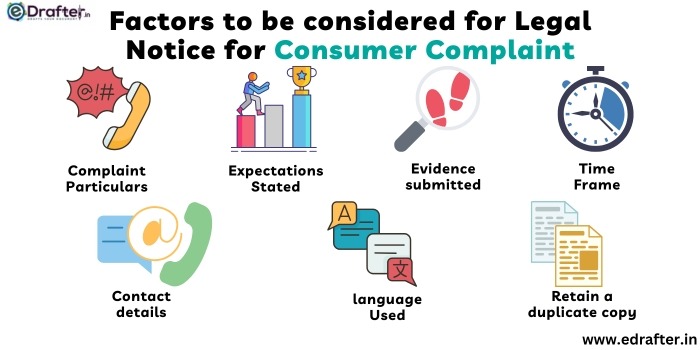
Factors to consider before sending the notice
- Complaint particulars — describe the problem clearly: the shortfall or defect in the product or service.
- Stated expectations — the relief you want: refund, replacement, or compensation.
- Evidence submitted — attach correspondence, receipts, and anything that supports your case.
- Time frame — give a specific, reasonable period for the recipient to respond or act.
- Contact details — include a phone number and email for further communication.
- Formal language — keep it professional and to the point.
- Keep a copy — you’ll need it as a reference, and potentially as evidence, later.
What should the legal notice format include?
- Sender’s details — your full name, address, and contact information at the top.
- Recipient’s details — their name, address, and contact number.
- Date — today’s date.
- Subject line — “Legal Notice,” with a brief indication of what the matter concerns.
- Introduction — a respectful opening before you introduce the issue.
- Complaint details — dates, what was bought or what service was availed, and what went wrong.
- Remedy requested — state clearly what you want: refund, replacement, or compensation.
- Deadline — a specific time limit for the issue to be resolved.
- Signature block — sign, and print your name underneath.
👉 Getting this format right matters — a vaguely worded notice is easy for the other party to ignore. eDrafter’s advocates draft to this exact structure so the notice carries real weight.
What happens if the recipient ignores the legal notice?
If the other party doesn’t respond or resolve the issue, you can proceed to file a complaint before the appropriate consumer commission. At that point, the legal notice becomes an important piece of evidence — it shows you acted in good faith and gave them the chance to resolve things first. Their silence can also work in your favour, strengthening your case and potentially leading to compensation and penalties being ordered against the business.
Is there a governing law for consumer complaints?
Yes — consumer complaints in India are governed by the Consumer Protection Act, 2019. The Act protects consumers against unfair trade practices, defective goods, and deficient services, and sets out a structured mechanism for filing complaints before District, State, and National Consumer Disputes Redressal Commissions, depending on the value of the claim. It also emphasises speedy, effective resolution of disputes.
How to Send Legal Notice for Consumer Complaints?
Sending one through eDrafter is simple and fully online:
- Visit eDrafter.in and go to the legal services section.
- Select the legal notice option and provide basic details about your consumer issue.
- You’re connected with an advocate experienced in consumer law.
- The advocate drafts the notice based on your facts and the legal requirements.
- You review the draft and request any changes.
- Once approved, the notice is sent to the other party through legally accepted modes, with proof of dispatch.
Do I need to attach documents to a consumer complaint legal notice?
You don’t have to. A legal notice is a formal letter stating your grievance — it doesn’t legally require supporting documents to be attached. That said, if you go on to file a complaint in consumer court, you will need to submit documents and evidence at that stage. So while attaching evidence to the notice itself isn’t compulsory, including key documents (receipts, correspondence, photos of the defect) can make the notice more persuasive and harder to ignore.
Also Read – How to Reply to a Legal Notice?
Why send your legal notice through eDrafter?
eDrafter makes the legal process accessible and stress-free — you don’t need to search for a lawyer or worry about legal language. Since 2016, we’ve drafted legal documents for 1.3M+ customers and are ISO 27001 and ISO 9001:2015 certified. You get expert drafting, full online convenience, transparent pricing, and proof that your notice has actually been sent. For consumers who want quick, reliable legal support without the runaround, it’s a practical way to get started.
FAQs
Is a legal notice mandatory under the Consumer Protection Act?
No — you can file a consumer complaint directly without sending a legal notice first. It’s strongly recommended, though, because it often resolves the issue faster and shows the court you attempted a genuine resolution.
Can I file a case without sending a legal notice for a consumer complaint?
Yes. You can approach the District, State, or National Consumer Commission directly, depending on your claim value, without a prior legal notice.
How much does a consumer complaint legal notice cost?
eDrafter’s Zapp service drafts and sends an advocate-stamped notice for ₹299 — suited to lower-value, straightforward disputes. For higher-value or complex matters, a personally drafted Custom Legal Notice starts at ₹1,799 with a free consultation.
How long does the recipient have to respond to a legal notice?
The notice itself sets the deadline — typically a reasonable period like 15 or 30 days, depending on the nature of the dispute. There’s no fixed legal minimum, but giving too short a window can weaken your position if the matter goes to court.
What if I don’t have the opposite party’s full address?
You need a reasonably accurate address for the notice to be validly delivered. If you only have partial details (a store location, a customer care address, or a registered office from their website), that’s usually sufficient — your advocate can advise on the best delivery method for your specific case.
Can I send the legal notice myself, or do I need an advocate?
You can technically draft and send one yourself, but a notice carries far more weight when it’s on an advocate’s letterhead — it signals to the recipient that you’re serious and prepared to escalate. Most people find the cost of an advocate-drafted notice (starting at ₹299) well worth it for that reason alone.
What happens after I send the legal notice?
The recipient can comply with your demand, negotiate, dispute it, or ignore it. If they don’t resolve the matter within the deadline given, you can proceed to file a formal complaint with the consumer commission — and the notice becomes evidence that you tried to resolve things first.
Conclusion
A legal notice for a consumer complaint is a powerful tool for asserting your rights and pushing for a quick resolution. It often settles disputes before they ever reach consumer court, and it strengthens your position if legal action does become necessary. Sending a well-drafted notice signals seriousness, professionalism, and awareness of your legal rights — 👉 and with eDrafter, you can send one easily, affordably, and with proper legal backing, without needing to find a lawyer yourself.

Disclaimer: This page is general information about legal notices for consumer complaints in India, not legal advice. Procedures and requirements are set by law and can change — confirm the current position with a qualified advocate before acting. eDrafter.in is not a law firm and acts as an intermediary between users and registered professionals.