Table of Contents
If a product you bought turned out defective, or a service you paid for was deficient, you can approach a consumer commission for redressal. But not everyone in every situation is entitled to file — the law is specific about who counts as a “complainant”.
This guide covers who can file a consumer complaint in India, who cannot, and how to actually file one.
Under the Consumer Protection Act, 2019, a consumer complaint can be filed by the affected consumer, their legal heir or representative, a registered consumer association, the government, the Central Consumer Protection Authority, or a group of consumers who share the same grievance. A person who bought goods or services purely for resale or commercial purpose generally cannot — with one important exception explained below.
What is a consumer complaint?
A consumer complaint is a formal grievance raised by a consumer against a seller, manufacturer, or service provider for a defect in goods, a deficiency in services, an unfair trade practice, or overcharging. It is filed with a Consumer Disputes Redressal Commission — commonly called a consumer court or consumer forum — under the Consumer Protection Act, 2019.
The Act exists to protect ordinary buyers from being cheated, and it gives them a relatively accessible route to a refund, replacement, or compensation without a full civil suit.
Grounds for filing a consumer complaint
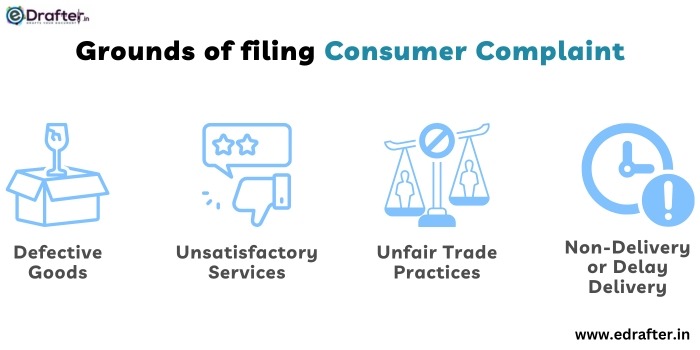
Before looking at who can file, it helps to know what you can file about. A complaint can be raised on any of these grounds:
- Defective goods — the product is faulty, damaged, or not of the quality promised
- Deficiency in services — poor, delayed, or incomplete service that fell short of what was agreed
- Unfair trade practices — misleading advertisements, false claims, or dishonest selling
- Overcharging — being charged more than the displayed, agreed, or MRP price
- Hazardous goods or services — products or services that are unsafe and put you at risk
- Non-delivery or delayed delivery — goods or services not provided as per the agreed terms
Who can file a consumer complaint?
Under the Consumer Protection Act, 2019, a complaint can be filed by any of the following:
- An individual consumer — a person who bought the goods or availed the service for their own use, and is affected by the defect or deficiency.
- The legal heir or legal representative — if the consumer has passed away, their legal heir or representative can file on their behalf.
- A recognised consumer association — a registered voluntary consumer organisation can file on behalf of a consumer, whether or not that consumer is a member.
- The Central or State Government — the government can file in the interest of consumers generally.
- The Central Consumer Protection Authority (CCPA) — the regulator established under the Act.
- One or more consumers, on behalf of many — where numerous consumers share the same interest, they can file a single joint complaint (a class-style complaint).
- A parent or legal guardian — where the affected consumer is a minor.
Who Can Not File A Consumer Complaint?
Not every buyer qualifies as a “consumer” under the Act. You generally cannot file if:
You are not the affected party. Someone with no direct connection to the defective product or deficient service cannot file a complaint about it.
You bought the goods or service for resale or a commercial purpose. The Act is designed to protect end-users, not businesses buying stock or inputs. The important exception: if you bought the goods or service for a commercial purpose but use it exclusively to earn your livelihood through self-employment, you are still treated as a consumer. For example, someone who buys a machine to run their own small business, and operates it themselves, is covered. [CONFIRM this exception with your reviewer.]
You received the goods or service free of charge. With no consideration paid, there is no consumer relationship under the Act.
Also Read; Types of Consumer Courts in India
How to file a consumer complaint online?
You have two routes — the official government portal, or a service that files it for you.
Option 1 — File it yourself on e-Daakhil
e-Daakhil is the government’s official online portal for consumer complaints. You can:
- Register an account on the e-Daakhil portal.
- Enter your complaint details and upload supporting documents and any required affidavit.
- Pay the filing fee online.
- Track the case as it moves to a hearing.
You do not legally need a lawyer to file on e-Daakhil — the system is designed for consumers to use directly.
Option 2 — Have it drafted and filed for you
If you’d rather not draft the complaint yourself — or you want it framed to survive scrutiny and to claim compensation, not just a refund — a service like eDrafter connects you with an advocate who drafts and files it.
- Tell us your issue on our Consumer Complaint page.
- We schedule a call with an advocate experienced in consumer law.
- The advocate drafts your complaint (or a legal notice first, if that’s the better first step).
- You review it, request changes, and approve.
Which consumer commission handles your complaint?
Where you file depends on the value of the claim:
| Value of goods/services + compensation claimed | Commission |
|---|---|
| Up to ₹50 lakh | District Commission |
| ₹50 lakh to ₹2 crore | State Commission |
| Above ₹2 crore | National Commission |
What Could Be The Punishment For Consumer Complaints?
The consumer protection act provides various remedies and punishments for the businesses that are
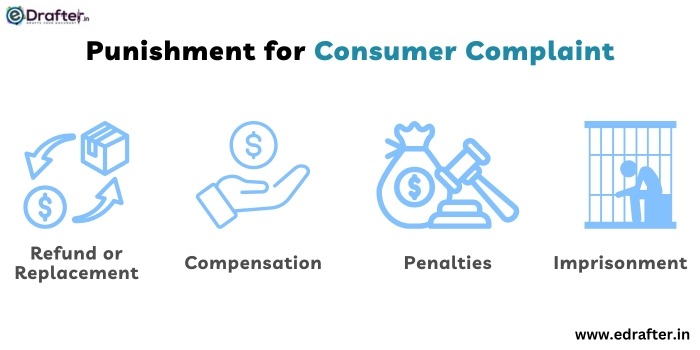
- Refund replacement- one of the primary outcome of the complaint is that the consumer are entitled to get full refund of the product, and if refund is not possible, then the service provider should replace the item with another product
- compensation- if the court orders the business to compensate the consumer for the financial losses and then convenience that is cost to the consumer, then the service provider should give the compensation to the consumer
- penalties- the service provider can also be charged for the penalties if it is seen that they are engaged in the unfair trade practices and charge penalties for the same
- imprisonment- in cases, such as fraud Or the cases that impose serious harm to the consumer. In those cases, the court can also order for the imprisonment
What remedies can you get?
If your complaint succeeds, a consumer commission can order any of the following:
- Refund of the amount paid
- Replacement of the defective goods
- Removal of the defect or deficiency in the goods or service
- Compensation for any loss or injury suffered, including for mental agony in appropriate cases
- An end to the unfair trade practice and, where relevant, penalties on the business
What you actually receive depends on the facts and what you can prove — which is why documentation matters.
Can I fight my own case in consumer court?
Yes. The Consumer Protection Act allows a consumer to represent themselves without an advocate, and the District Commission process is designed to be accessible. For straightforward cases, many people file and appear on their own.
That said, for complex matters, or cases before the State or National Commission, professional drafting and representation make a real difference — a poorly framed complaint can be delayed or dismissed, and claiming compensation beyond a refund needs to be argued correctly.
Frequently Asked Question (FAQs)
Who can file a complaint in consumer court in India?
The affected consumer, their legal heir or representative, a registered consumer association, the Central or State Government, the Central Consumer Protection Authority, or a group of consumers sharing the same grievance. A parent or guardian can file where the consumer is a minor.
Can I file a consumer complaint if I bought the product for my business?
Generally no, if it was for resale or commercial purpose. But there’s an exception: if you use the goods or service exclusively to earn your livelihood through self-employment, you’re still treated as a consumer and can file.
Can I file a consumer complaint without a lawyer?
Yes. You can file directly on the government’s e-Daakhil portal, and consumer commissions are designed to let people represent themselves. A lawyer helps mainly with complex cases or when claiming compensation beyond a refund.
Where do I file my consumer complaint?
At the District Commission for claims up to ₹50 lakh, the State Commission up to ₹2 crore, and the National Commission above that — filed where you live, where the opposite party operates, or where the cause of action arose.
What is the time limit to file a consumer complaint?
Generally two years from the date the problem arose. A commission may allow a late filing if you show good reason.
Can a legal heir file a consumer complaint?
Yes. If the affected consumer has passed away, their legal heir or legal representative can file the complaint on their behalf.
What can I claim in a consumer complaint?
A refund, replacement, removal of the defect, and compensation for loss or injury suffered. You can also seek an order stopping an unfair trade practice.
Is there any fee to file a consumer complaint?
Yes, a filing fee applies and it varies with the value of the claim. It’s paid online when you file on e-Daakhil.
Disclaimer : This page is general information about consumer complaints in India, not legal advice. Eligibility, jurisdiction limits, fees and procedures are set by law and change from time to time — confirm the current position with the relevant Consumer Commission or a qualified advocate before acting. eDrafter.in is not a law firm and acts as an intermediary between users and registered professionals.