
Cheque Bounce Legal Notice
Quick Eligibility Check
Confirm these 4 points to unlock the form + live editor (NI Act 138).
Once unlocked, the form + live editor will appear below.
A cheque bounce (dishonour) legal notice is used when a cheque issued against a legally enforceable debt or liability is returned unpaid (e.g., Insufficient Funds, Account Closed, Payment Stopped, Signature Mismatch). This is generally the first formal step before filing a case under Section 138 of the Negotiable Instruments Act, 1881.
When can this notice be used?
- Invoice payment cheque bounced
- Loan repayment cheque dishonoured
- Business payment default by cheque
- Settlement cheque failed
- Any cheque for a legally enforceable debt
Who can use this notice?
- Individuals, freelancers, startups
- Firms & companies
- Cheque payee / holder-in-due-course
Typical bounce reasons
- Insufficient funds
- Account closed
- Payment stopped
- Signature mismatch
Zapp Innovation
- Auto draft + mandatory advocate verification
- Notice sent only after approval
- Refund if not approved
The Draft was Updated by Zapp Legal on 19/02/2026
How ZAPP Works
Send a lawyer-drafted legal notice in minutes with our simple 5-step process.
Fill Form & Upload Proof
Enter details and upload supporting documents to start your legal notice.
Pay Securely 299/-
Make payment through our secure online system.
Advocate Review
A licensed advocate reviews your notice.
Seal & Stamp
Your notice is sealed & stamped by Advocate.
Notice Sent
The legal notice is delivered via email, Whatsapp, courier (as per the service choosen) to the other party.
 Cheque Bounce Success Stories

bounced after delivery payment.

returned unpaid by bank.
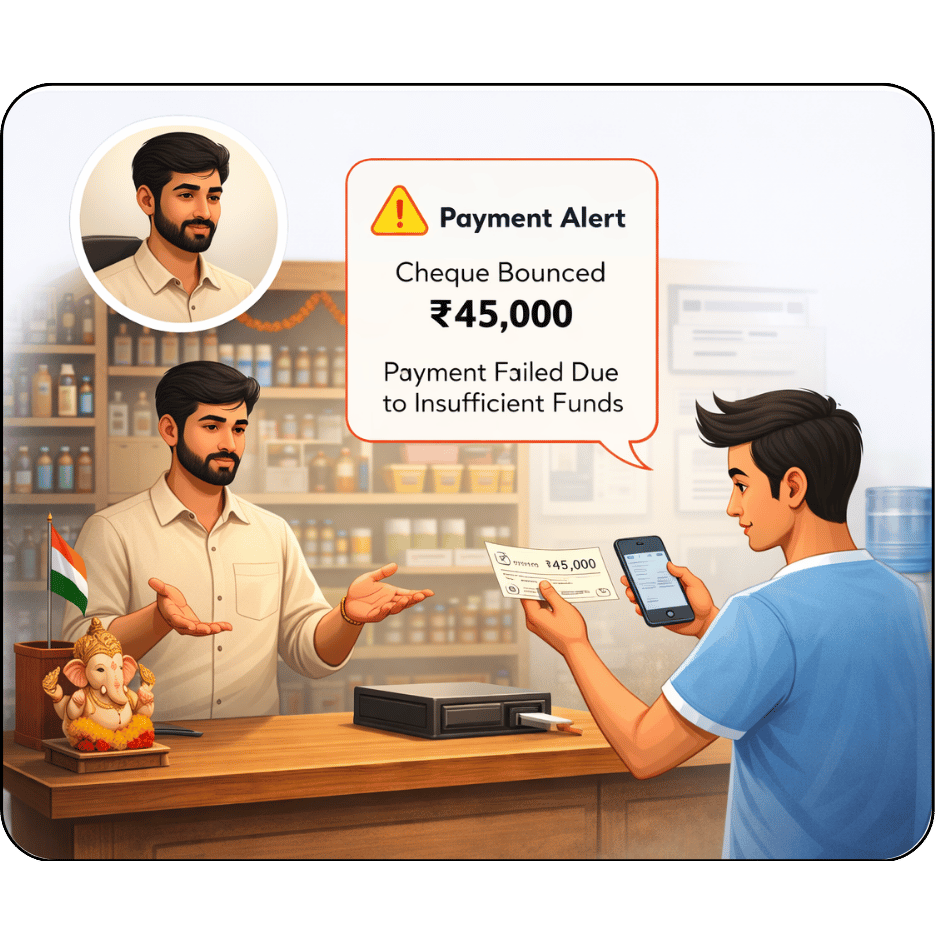
bounced due to insufficient funds.
Cheque Bounce Legal Notice FAQs
Yes, you could take legal action if a cheque given to you is returned unpaid by the bank. A bounced cheque means the payment was not completed, usually because of insufficient funds or account issues. The law allows you to first send a legal notice asking the person to clear the payment within a fixed time. If they still do not pay, you can file a cheque bounce case in court. Many matters get resolved once the notice is sent, because the issuer understands that ignoring it can lead to criminal proceedings and penalties.
Cheque bounce is treated as an offence under Section 138 of the Negotiable Instruments Act, 1881. This law makes it punishable if a cheque is dishonoured due to insufficient funds or similar reasons and the payment is not cleared even after receiving a legal notice. The section was introduced to ensure trust in cheque transactions and prevent the misuse of cheques for payments. If the drawer fails to pay within the legal time after notice, the payee has the right to file a criminal complaint. Courts take such cases seriously because cheques are widely used for financial transactions.
If someone is found guilty in a cheque bounce case under Section 138, the court may order imprisonment of up to two years, or a fine that can be up to twice the cheque amount, or sometimes both. The court may also direct payment of compensation to the complainant. However, many cases are settled before reaching final judgment, as the accused often agrees to pay the amount to avoid punishment. The exact outcome depends on the facts, evidence, and whether the parties settle during the case.
A legal notice must be sent within 30 days from the date you receive the bank memo informing you that the cheque has bounced. The notice asks the issuer to make the payment within 15 days of receiving it. If the payment is not made within that period, you then get the right to file a cheque bounce complaint in court. Following this timeline is very important, because missing these deadlines may weaken your legal case or prevent you from filing under Section 138 of the NI Act 1881.
The most common reason for a cheque bounce is insufficient funds in the account. Other reasons include signature mismatch, overwriting on the cheque, incorrect date, account closure, stop-payment instructions, or technical errors in cheque details. Sometimes cheques also bounce because they are presented after the validity period expires. Regardless of the reason, if the cheque was issued toward a legally payable debt and remains unpaid after notice, legal action may still be possible. The bank return memo usually mentions the exact reason for dishonour.
Yes, sending a legal notice is a compulsory legal step before filing a cheque bounce complaint under Section 138. The law requires the payee to give the cheque issuer a final opportunity to make payment within 15 days of receiving the notice. Only if the payment is not made within this period can a complaint be filed in court. Without sending this notice within the prescribed time, the case may not be maintainable. So, the legal notice is not just a formality, it is a required part of the legal process.
Yes, a legal notice is mandatory. After the cheque is dishonoured, you must send a written demand notice within the legal time limit asking for payment. This notice officially informs the issuer that the cheque has bounced and gives them a final chance to clear the amount. If they pay within the allowed period, the matter ends. If they fail to pay, you can then file a criminal complaint. Courts strictly check whether the notice was sent properly and within time before accepting the case.
You will generally need the original cheque or its copy, the bank return memo showing the reason for dishonour, proof of the transaction or liability, and basic details of the person who issued the cheque. Communication records related to the payment may also help. These documents allow the legal notice to clearly mention the cheque number, amount, bank details, and dishonour date. Keeping proper records helps strengthen your case and ensures the notice contains all necessary legal information.
Yes, an offence under Section 138 of the Negotiable Instruments Act is generally considered a bailable offence. This means the accused can apply for bail and usually get released after fulfilling the required legal conditions. Although it is bailable, the case is still treated as a criminal matter, and the accused must attend court proceedings. The case may continue until payment is made, settlement is reached, or the court gives its final decision.
Normally, cheque bounce cases must be filed within the specific legal time limits set under Section 138. After sending the notice and waiting for the 15-day payment period, the complaint must generally be filed within one month from the cause of action. Filing after a long delay, such as two years, is usually not allowed unless the court accepts the delay for strong reasons. Therefore, it is always better to act quickly once the cheque is dishonoured.
Cheque bounce cases are usually handled through the court system rather than direct police investigation. Since it falls under a specific financial offence law. You typically file a complaint before a magistrate, not at a police station. However, once the court takes cognisance, legal summons and proceedings follow. Police involvement generally happens only for procedural purposes, such as serving notices or warrants if ordered by the court.
To defend against a cheque bounce case, the accused must show that the cheque was not issued for a legally recoverable debt, or that payment was already made, or that the cheque was misused. Proper documents, bank records, or communication proof can help support the defence. Responding to the legal notice and attending court hearings is important. Many accused persons also try to settle the amount during the case, which courts usually allow, helping close the matter faster.
Yes, you can send a notice yourself, but it is strongly recommended to send it through a lawyer. Cheque bounce cases follow strict legal timelines and requirements. A professionally drafted notice ensures the correct facts, dates, cheque details, and payment demand are properly mentioned. Even a small mistake in timing or format can weaken the case. Using a lawyer helps avoid errors and increases the chances of successful recovery.
Cheque bounce matters in India are governed mainly by Section 138 of the Negotiable Instruments Act, 1881. This law makes it a non-bailable offence to issue a cheque that gets dishonoured for insufficient funds or similar reasons, provided the payment is not made even after receiving a legal notice. The law sets strict timelines for presenting the cheque, sending the notice, and filing the complaint. Its purpose is to maintain trust in cheque payments and ensure financial commitments are honoured.
Zapp works simply! - just fill a form to draft your legal notice using our live editor. After that our senior advocate will review your notice, make corrections if required and Seal & Stamped to send it to to other party. Please note that the legal notice shall be sent on an official letterhead of the advocate.
If our advocate find your drafted notice invalid and it gets rejected, you will get your full amount refunded.
The advocate review and dispatch is available from 9:00 am to 6:00 pm (Mon-Fri). However, you can draft your legal notice 24*7.
You can send another legal notice by drafting another one or you can go for legal proceedings through court. We also offer litigation service that you can opt for.
If you don't get your resolution b sending zapp legal notice, You can send another legal notice to other party or you can go for legal proceedings through court. We also offer litigation service that you can opt for.